In brief
OCI E6 Standard Compute is the next AMD x86 generation to evaluate when you are choosing between VM.Standard.E6.Flex, VM.Standard.E5.Flex, and VM.Standard.E4.Flex. If you are starting a new OCI workload today, E6 should be on the shortlist before E5 or E4.
The reason is simple: Oracle positions E6 as a newer 5th Gen AMD EPYC-based generation with better performance at the same price point as E5 in its launch messaging. That does not make old benchmarks useless, but it changes the next decision: every existing E5/E4 benchmark should now have an E6 follow-up.
Quick answer
| Situation | Best first move |
|---|---|
| New AMD x86 workload on OCI | Test VM.Standard.E6.Flex first. |
| Existing E5 workload | Benchmark E6 with the same OCPU, memory, image and region before migrating. |
| Existing E4 workload | Compare E6 against both cost and compatibility assumptions; E4 is now an older baseline. |
| ARM-compatible workload | Still compare with VM.Standard.A1.Flex if cost is the main driver. |
| Network-heavy workload | Watch the Acceleron variants, not only the base E6 shape. |
This post is not a final benchmark yet. It is the decision map I would use before running the next set of tests.
What changed with OCI E6
Oracle announced OCI Compute E6 Standard as a new generation powered by 5th Gen AMD EPYC processors. In the launch post, Oracle says E6 can deliver up to 2x the performance of E5 at the same price and up to 50% better VM price-performance, depending on workload and configuration.
That matters because the previous OCI compute comparison on this site found VM.Standard.E5.Flex as the strongest multicore performer among E5, E4, A1, Standard3 and Optimized3 in my Geekbench 6 test: OCI Flex Shapes: E5 vs E4 vs A1 .
With E6 available, that older benchmark becomes a baseline, not the end of the story.
E6 vs E5 vs E4
| Shape family | Architecture | How I would read it today |
|---|---|---|
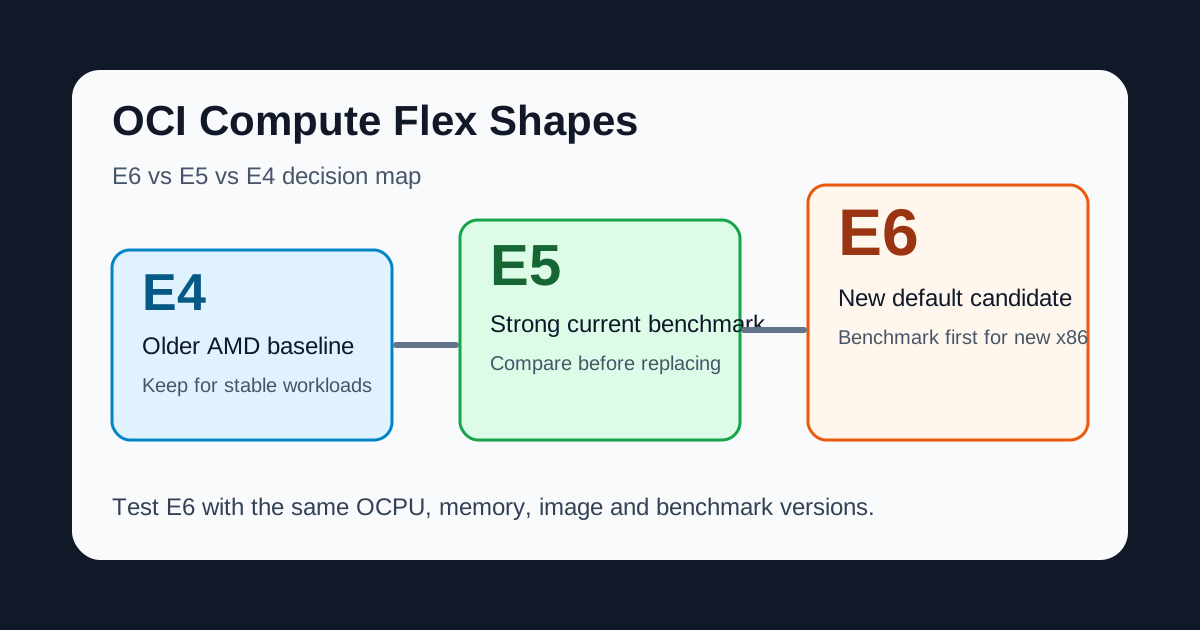
| VM.Standard.E4.Flex | AMD x86 | Older AMD baseline. Keep it for stable workloads, but do not use it as the default for new performance-sensitive deployments. |
| VM.Standard.E5.Flex | AMD x86 | Strong performer in the previous benchmark. Still relevant where E6 is not available, not certified, or not yet tested for your workload. |
| VM.Standard.E6.Flex | AMD x86, newer generation | New default candidate for AMD x86 Flex workloads. It needs direct testing against E5 and E4 with the same workload profile. |
The important point is not just CPU generation. In OCI Flex shapes, the actual decision usually combines CPU, memory per OCPU, network behavior, regional capacity, image support, licensing and application architecture.
When to move to E6
Choose E6 first when you are building something new and you need x86 compatibility. There is little reason to start with E4 unless you have a specific availability, certification or cost constraint.
Run a controlled E6 test when you already run on E5. Use the same:
- OCI region and availability domain if possible
- OCPU count
- memory allocation
- operating system image
- boot volume type
- benchmark version
- application runtime version
Keep E5 or E4 when the workload is vendor-certified only on those shapes, when regional capacity is not ready, or when a benchmark shows no real gain for your specific application.
What I would benchmark next
For a useful E6 article, I would not run only one synthetic benchmark. I would test at least four angles:
| Test | Why it matters |
|---|---|
| Geekbench 6 multicore | Continuity with the existing OCI benchmark data. |
| PHPBench or application runtime benchmark | Shows whether real runtime behavior follows the synthetic score. |
| OpenSSL or compression test | Useful for backend services, gateways and data pipelines. |
| Network and storage throughput | Important because many cloud workloads are not CPU-bound. |
The first fair comparison should be:
VM.Standard.E4.FlexVM.Standard.E5.FlexVM.Standard.E6.Flex- same OCPU count, starting with 2, 4 and 8 OCPUs
- same OS image
- same benchmark versions
Then I would add a second article focused on cost-performance, because the most interesting question is not only “which one is faster?” but “which one gives more useful work per euro or dollar?”.
Where Acceleron fits
Oracle also announced Oracle Acceleron Compute Shapes, including E6 Standard Acceleron and E6 DenseIO Acceleron. This is a separate but related opportunity.
The key idea is that Acceleron adds infrastructure acceleration through SmartNICs and offload capabilities. That means it should not be treated as just “E6 with a slightly different name.” It deserves its own article because the search intent is different:
- E6 search intent: “which CPU shape should I choose?”
- Acceleron search intent: “what changes in OCI networking, storage access and infrastructure offload?”
For now, the practical takeaway is this:
| If you care about… | Look at… |
|---|---|
| General AMD x86 compute | VM.Standard.E6.Flex |
| Replacing E5/E4 for normal workloads | E6 Standard |
| High-throughput network/storage workloads | E6 Acceleron and E6 DenseIO Acceleron |
| GPU and AI infrastructure direction | A4 Standard Acceleron |
My recommendation
If you are planning a new OCI deployment, do not treat E5 as the automatic AMD x86 default anymore. Start with E6, then prove the decision with your workload.
If you already run on E5, do not migrate blindly. The safe path is a small benchmark, then a canary deployment, then a controlled rollout.
If you are still on E4, this is a good moment to re-open the sizing discussion. The right answer may be E6, E5, A1, or even a different shape family, but E4 should no longer be the only baseline in the conversation.
Sources
- Oracle announcement: OCI launches E6 Standard Compute powered by AMD
- Oracle documentation: Compute shapes
- Oracle announcement: Oracle Acceleron Compute Shapes
FAQ
What is VM.Standard.E6.Flex?
VM.Standard.E6.Flex is the E6 generation of OCI Standard Compute flexible virtual machines, based on newer AMD EPYC processors than the E5 and E4 generations.
Should I choose OCI E6 instead of E5?
For new AMD x86 workloads, E6 should be the first shape to evaluate. For existing E5 workloads, run a like-for-like benchmark before migrating.
Is Oracle Acceleron the same thing as E6 Standard?
No. E6 Standard is the compute shape generation. E6 Standard Acceleron is part of a newer Acceleron family that adds SmartNIC-based network and infrastructure acceleration.